Shikoku 88 Temples Pilgrimage: Day 0
Osaka to Ohenru (pilgrimage) at Uchiko
I arrived in Osaka, strangely not jet-lagged. I guess my usual sleeping patterns help me to deal well with long-haul flights.
As always when arriving, it feels as though, after all these hours, I’ve landed in the same place from where I set off. But Osaka airport does feel a little different. It’s full of older employees holding up visuals to tell you which queue to join. Here is the queue for people who have digital passes, and a picture of the computer screen. Here is a queue for the idiots who couldn’t work it out, and I follow the picture of a cream paper form to the left.
Outside the airport, I discover I am without internet and must use my non-existent Japanese to find a connection into Namba, the part of Osaka where I’ll be staying. Pointing at Hiro’s spreadsheet of my itinerary is going to get me a long way, I find already.
On the train into the city, an older Italian man chats with a group of university students, who find him hilarious, to his delight and their great amusement. One girl keeps saying, “I don’t know! I don’t know!” In response to his questions, and then throws out a phrase she does know: “I am a beautiful girl, no?” And she laughs.
At Namba station, Hiro is waiting, unchanged,. I give him a hug, even though I’ve read it’s not allowed. But he only spends a few weeks a year in Japan. His etiquette must be muddled enough by now.
We walk together through the streets of Namba. Hiro keeps telling me, “I’m not from here, you know?” as we get lost again and again. He takes me to my hotel and then waits downstairs for me to come out again for a long and difficult search for a SIM card and a thermos flask, two things: each of which is deemed unnecessary by one of us and indispensible by the .
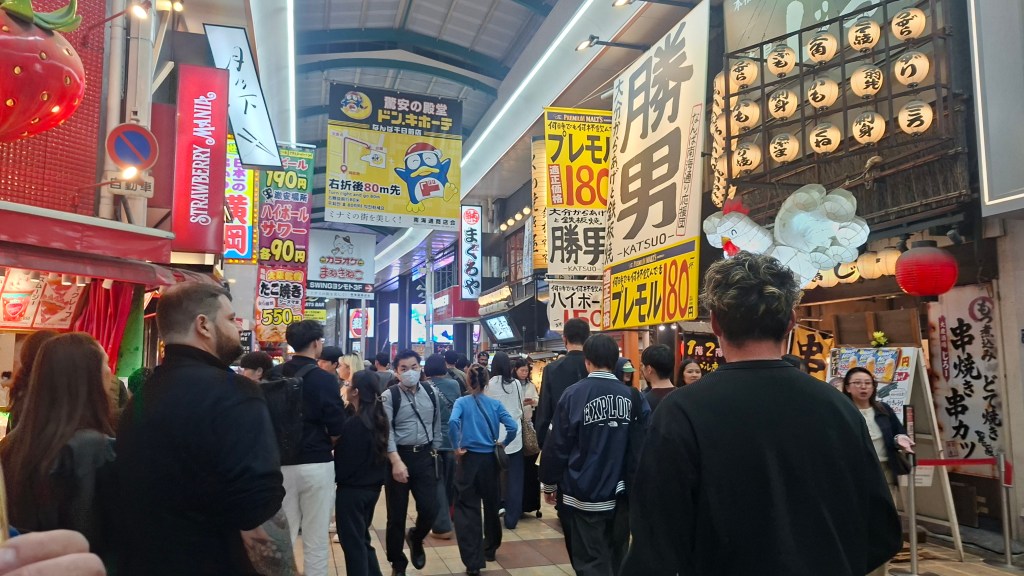
Having got both, we go for dinner. Hiro has told me before I start the walk, I must practice with chopsticks and eating raw fish, and so the test begins. I’ve already had to admit that my attempt to learn Japanese was quite half-hearted until recently, and there’s not much to show him there. But as we walk to the restaurant, he teaches me left, right, straight ahead, cross the road, up and down, and tells me I’m a good student. I feel slightly less ashamed.
When we find the place recommended by the hotel, we sit in the low-tabled section at the back, and the first issue arises, when Hiro sits down cross-legged on the floor and I struggle to sit at the table at all. “But every Japanese person can do it!”, he says in dismay. He gives me some extra cushions and instructs me to stick my legs out under the table in front of me, like a giant baby.
Then the food starts coming. “Just enjoy” is the main instruction, but Hiro cannot withhold the occasional sharp intake of breath as I make one faux pas after another. Even getting up onto the raised area, I’d almost forgotten to take my shoes off. That one I knew. But now come all the others.
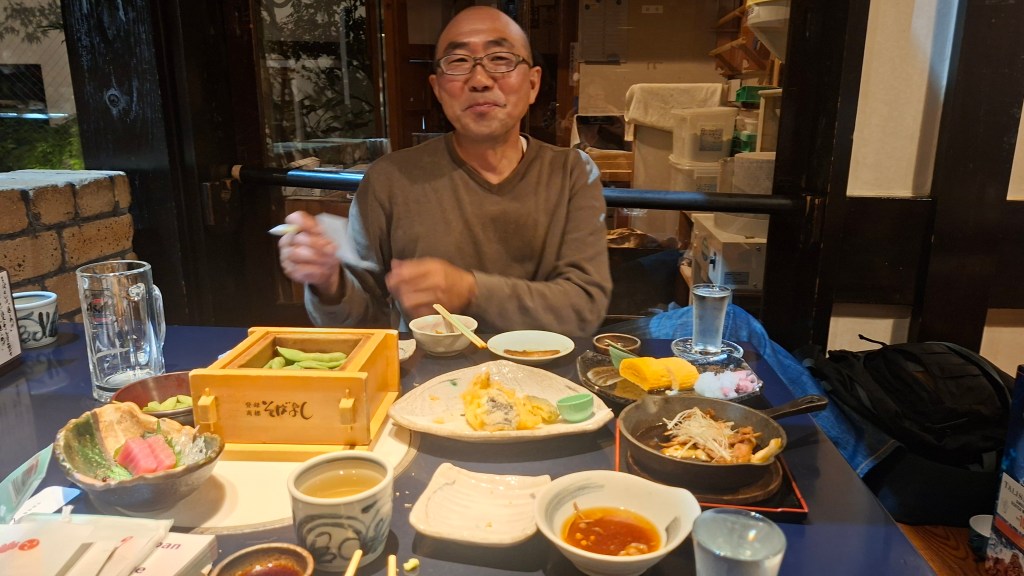
The chopsticks must not be put down on the bowl but to the side of the bowl between mouthfuls. The chopsticks must be held like I’m holding a pen. I don’t tell him how inky my fingers used to get at school. The chopsticks must be held 70% up the stem.
Worst of all, when holding a bowl, he’s horrified that I hold the rim with my finger, not my thumb. “I can’t tell you why,” he sa, “but it’s not good.”
And as I eat, I keep practising, trying to get everything right in one go: to pick up the noodles correctly, to slurp the noodles, to put the chopsticks back to the side, to drink the sauce from the noodles with my thumb on the rim of the bowl. And eventually I get there and the sharp intakes of breath stop.
Another thing I learn is that I need to drink my beer more quickly because the sake has come to the table, and this needs to be eaten with the food. The glasses are filled up to the brim, if not slightly above, which I’m told is normal, so I can lean forward and slurp the sake too.
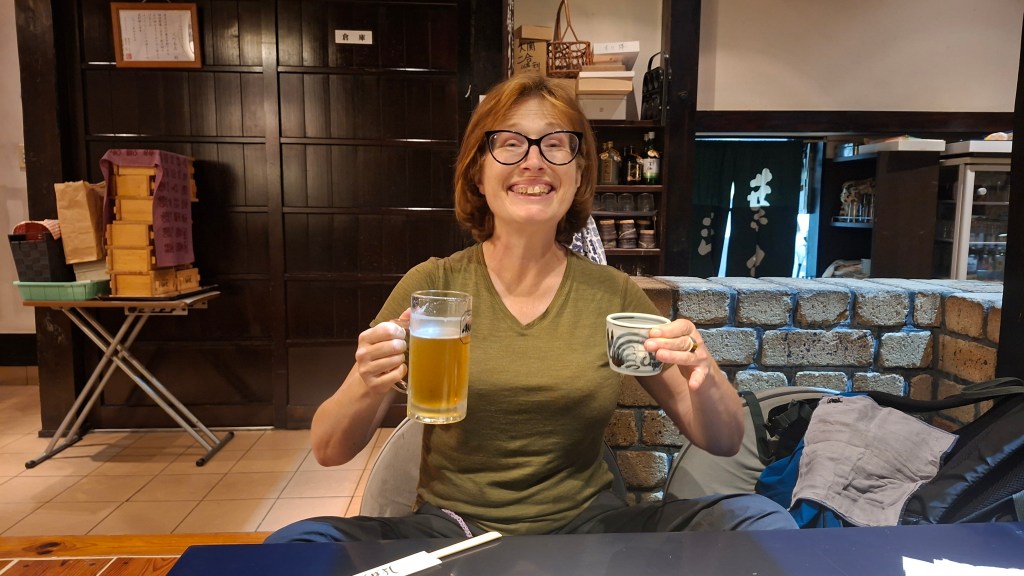
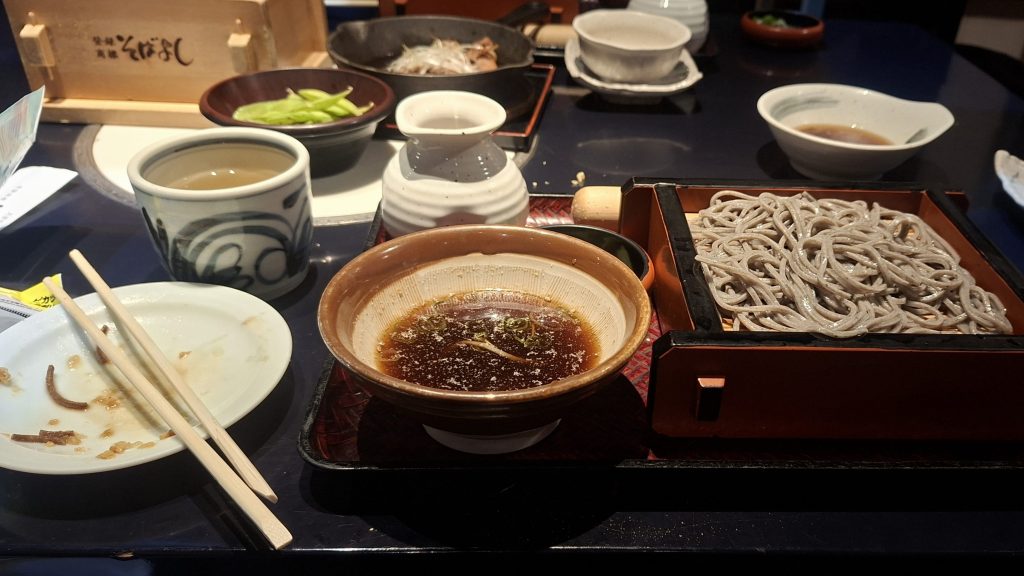
The meal is huge. And then the soba noodle course comes. I enjoy it all, but I’m quite relieved when Hiro says the second restaurant he’d been planning, where I could learn to eat ramen, we won’t go to, in consideration of my having said earlier that I wasn’t very . I am somewhat relieved.
As the meal is taken away, he brings out the bag of gifts, and I am overwhelmed by his ongoing generosity: my book for the temple calligraphy, my name slips to hand in at the temples, or to anyone who’s nice to me en route, a complete kit for lighting candles and incense, a brand new guide book, which I note has been annotated all the way through with tips and every place I must stop at highlighted, a charm to put on the back of my bag, athletic tape, reflective cuffs “for “tunnels” a foot massage ball, and headscarf to wear like the one that he wore on the Camino. And then, the pièce de resistance, a bag to put my laundry in, on which he has written my name in hiragana, so I’ll never lose my underwear.
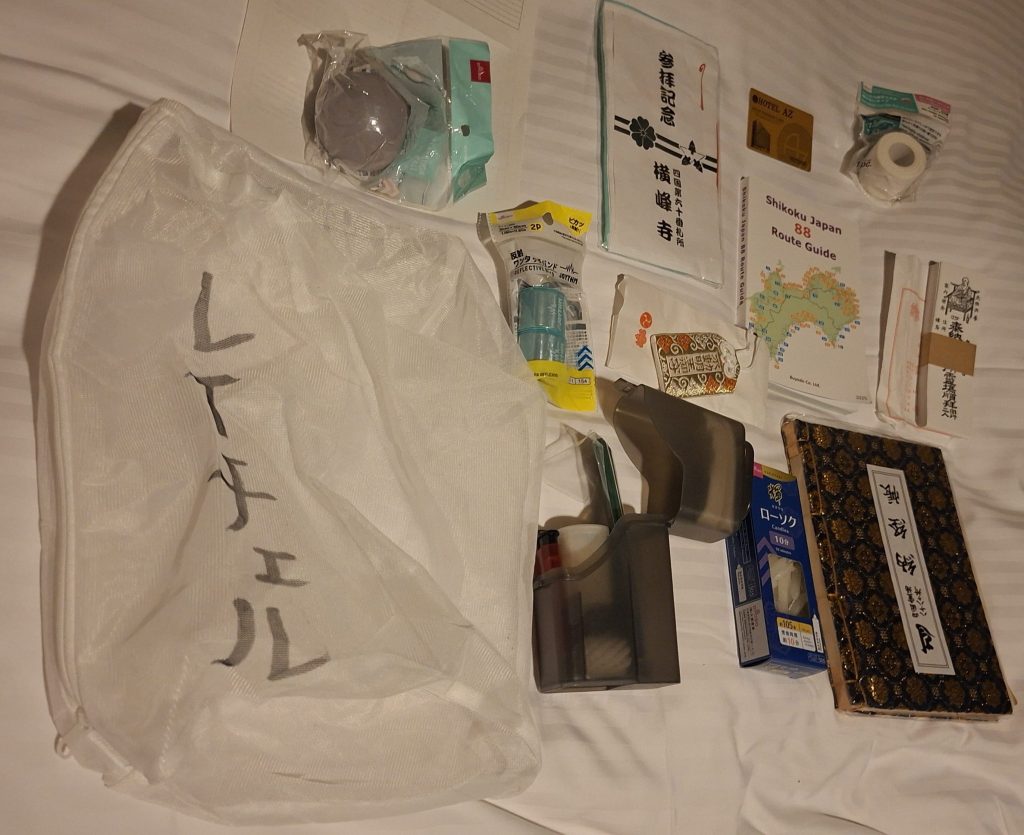
I also realize my rucksack is now going to be too heavy to carry, and I think about all the wrong items I’ve packed, which will need to be disappeared before I start walking.
He takes me back to the hotel and leaves me there. Now it’s me and Japan. But I think as I sit in my room with my tiny bathroom and toilet with a hundred switches and a warm seat, I think Japan and I will get on fine.
And the next morning I’m off. After my only lie-in for this trip and the buffet breakfast, I go to nearly miss the bus to Matsuyama, the bus which I booked a month ago on a mountaintop in Spain. I leave in good time and stroll to the wrong bus station and then run across town to get to the right one just in time.
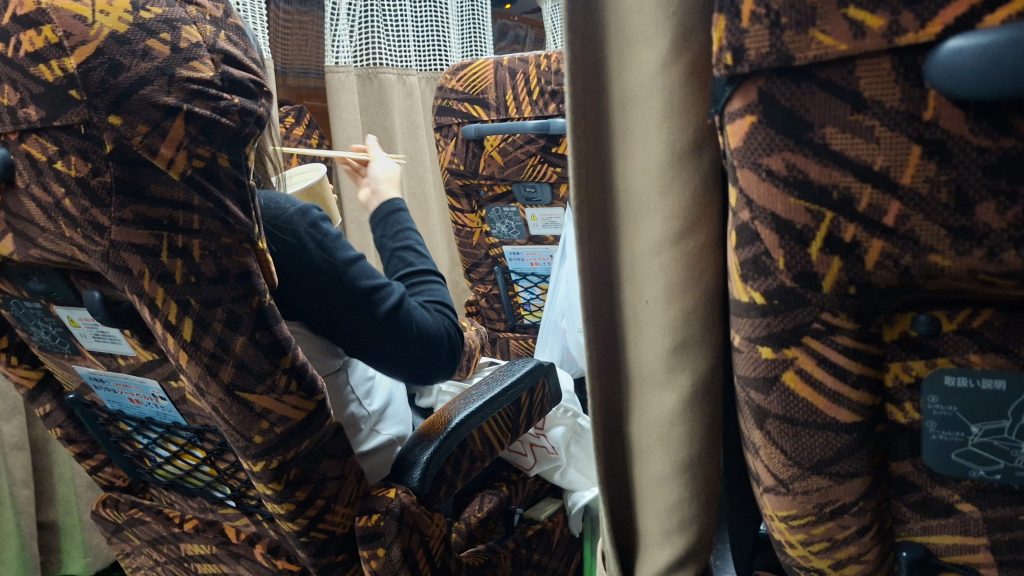
The bus is as beautifully thought out as the toilets. This is what I love about Japan. They’ve thought everything through, thought how to make everything as convenient as possible. Every seat has a footrest. There are three rows of single chairs. There are curtains between the chairs. There are two long stops to use toilets or buy snacks from the shop.
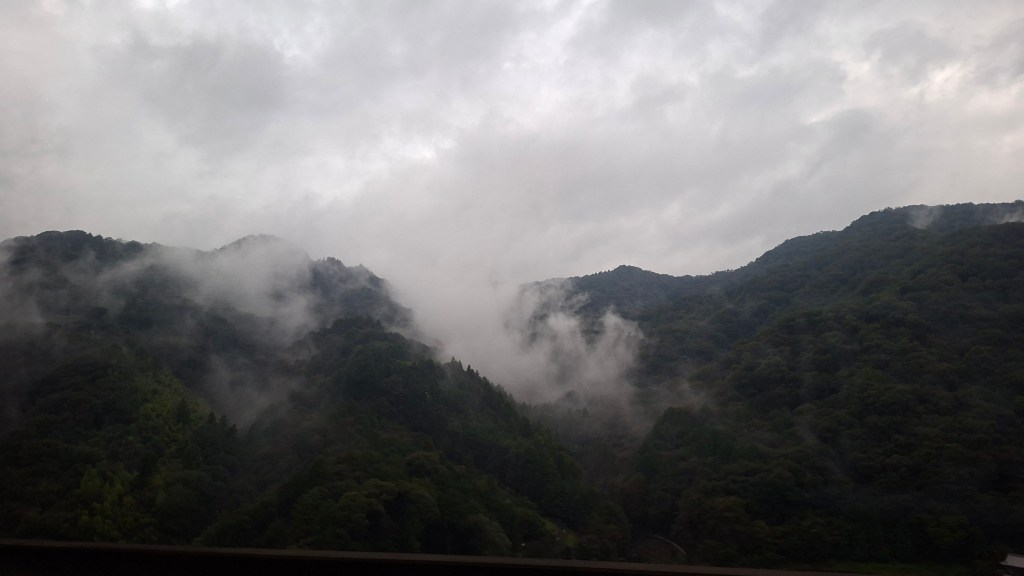
I look out of the windows as eventually the scenery changes. As we leave Osaka and enter Shikoku, massive mountains rise, and the rain falls down in buckets.
Six hours later, I arrive in Matsuyama, and it’s dark already, but at least the rain has stopped. On the platform where I wait for my train, there’s a huge crowd of schoolchildren, me, a middle-aged woman, and a youngish man dressed in traditional Japanese gear, with his hair in a little bun, a long robe, and wooden flip-flops.
But all of us are equally impressed when, on the platform opposite, a train arrives, playing music, lit up, full of people waving from their little tables, as a red carpet and a banner are set up for as they step out. As the train pulls in, the children wave dutifully back. None of them know each other. It’s just right to wave when you’re on a very exciting, lit-up, musical train, and it’s right to wave at people who are having such a lovely experience.
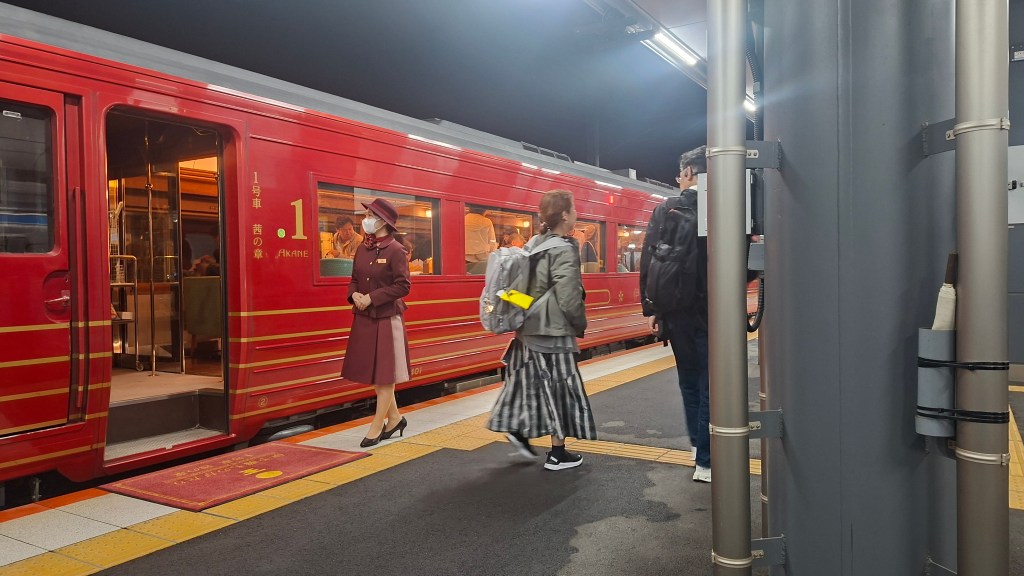
Next, it’s the turn of my train. As the tiny train pulls up, I wonder how everyone will fit on, but I now realize the crowd of children is a queue, and they all go in in an orderly fashion at the far end of the train, and I join the queue. Eventually, as we all get off at our stations, we go to the other end of the train to get off, where a man will take our tickets. So well thought out. Everything is so well thought out.
And now I’m in Uchiko, a town that feels in the middle of nowhere, in the pitch black, looking for a hotel. When I find it, all I want to do is climb into the bed, ut Hiro’s notes tell me, “Don’t forget to buy lots of food for day two.” So I go to the supermarket across the road.
What a delight! At first I can’t think what to buy, but eventually I can barely leave for things I want to try. I leave with sweets and puddings and strawberry-flavoured cheese and red bean paste and ‘hotel’ bread and a bento box, which I’m determined I will eat every scrap of.
I ask the woman at the counter if I can eat the bento uncooked. “We have a microwave here,” she indicates. (I should point out on this trip very little language is exchanged unless a translator is used). And she heats up my meal for me and checks it’s hot enough before I go on my way.
As I walk back to the hotel, I am curious to know what other delights Shikoku island will hold. Hiro’s itinerary feels like a passport to another well-thought-out world.


Leave a Reply