Home to Santiago: Day 3
Offranville to Saint-Maclou-de-Folleville: 32km
In the early hours, I realise I’ve packed for the heat, but not for a pleasantly mild spell in Normandy. I zip up my rain jacket over my legs, put on a hat and disappear into my sleeping bag. This is the first and last time I travel without the foil blanket.
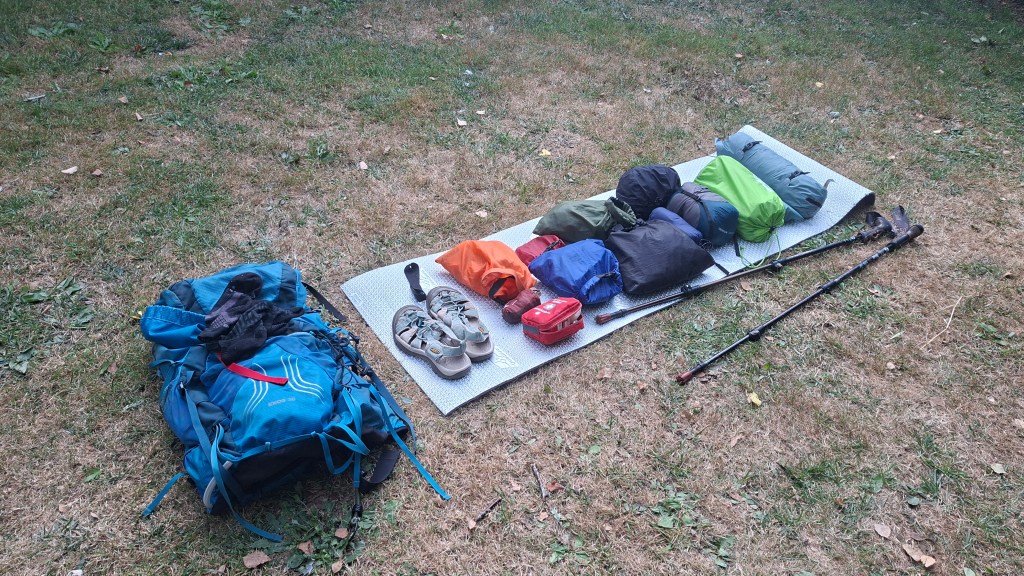
In the morning, having thought too much about what I didn’t bring, I lay out my camping things as I take the tent down. The colour-coded order of it reassures me, and I go and have breakfast outside the toilet block where my phone is charging. Early morning dog walkers from the campsite hurry by.
I set off to Offeanville, hoping to get a stamp from the beautiful twisty-spired church. But, as usual, the church is closed and the bar is open. And it is a beautiful bar. All around the top of the walls are photos of the regular clientele, with their nicknames underneath. The Artichoke gets me wondering, one of the few women customers. Most of them you can just about work out: who’s strong, who’s silent, who loves a football team a bit too much.

I stand at the bar, drinking coffee, while a regular man plays with my sticks and practises his Nordic walking. I get my stamp and leave. Everyone is very polite, as always, and that seems to be my theme for today.

I start musing about friendliness in France. What I decide, and I will be proved wrong to such a huge extent later, is that the French are polite rather than friendly. Less friendly, perhaps, than the south of England. I wonder if that is just because they just can’t understand what I say.
However, in a small village, mid-morning, this theory is proven wrong. I force myself to walk past a small village shop I had not been expecting, but turn back moments later. “I couldn’t resist” I say to the lady outside, who had seen me pass.
“Why should you resist?” she replies, looking uncomprehendingly at me. “It is a grocery shop”.
When I go into the shop and the woman comes out to serve me, I say, “What a lovely surprise this place is.”
“Why is it a surprise?” she asks. “It is a grocery shop”.
But they do all the bonjours and au revoirs. I think they may all be just too sophisticated to engage with my fripperies.

In the string of villages along the banks of the Scie everywhere there are the distinctive timber-framed houses, occasional mansions, a few farms, some holiday homes, always the Mairie. Every village has a church which is a little bit different, which I like; almost English, but definitely French. The path meanders by the river, occasionally climbing up into the hills. The villages are quiet, well-to-do, and mostly without shops, surprisingly irresistible or otherwise.


The River Scie, which I will later be proudly told is an independent river (“It has its own source and flows straight into the sea!”) is really just a lovely big independent stream. It is also what I will be following, more or less, all day.

When I get to Longueville-sur-Scie, I see signs for the castle and make my way up by a shortcut, which pleases me as I end up going through what would have been the old front gates, up a rather steep slope. The sort of slope in Hungary where I would have sent Krisz up to take photos. But no, I have to do it myself. The small group who have come in by the regular entrance on the road see me appear and look at me like an invader.
I park up for a bit and go into one of the old ruined watchtowers in the walls and look down the steep wooded hill that drops away behind the holes in the walls, which I guess were once windows. I am very happy to see that someone has been sleeping here, that the castle is still, in a way, inhabited.


I walk up past the group to get a view of the castle proper, and they all say bonjour, very politely. I look at the plans and think: this is what the Normans brought to England, parcels of land, villages around mansions, the feudal system. This sets me thinking for a bit. You do think a lot about land ownership when you are walking.


In Longueville, I discover crudité means I get salad in my baguette, and indulge in a healthy jambon beurre and salad baguette before striking off to follow the Scie again, occasionally meeting the railway that shares the same valley, occasionally being sent on paths on the wooded valley sides.


I read the signs. I’m starting to work them all out. I’m impressed by a new and very sophisticated style of pathgate. I admire what seem to be thoroughbred horses in the fields all around.


Much to my delight, in one wooded section, I see two walkers coming the other way with rucksacks and sticks. Two Frenchmen walking from Rouen to Dieppe. They stop and chat, and they attempt to understand my French, before the younger one suggests we switch to English.
I tell them where I’m going, and they are brilliantly unimpressed. The older man wants to carry on chatting, but the younger man clearly wants to continue. I wonder if he walks with him to keep his friendliness in check. So I leave them with a “bon courage”. This at least has come back to me.

In Auffay I sit in the market square and eat yoghurts. I am craving yoghurt constantly on this walk. I also visit the famous and very beautiful church, but first things first.


When I eventually get near to my destination, I call the number I have been given, and Bernard answers and struggles to understand a word. But I do get the message that, within half an hour, someone will be there to greet me.
When I arrive, ten minutes later. Daniele is already there. She greets me and gives me a wonderful private tour of the mill, the community area, and the bakehouse. She shows me the swamp land behind and tells me all about the community’s plans to keep this in community hands, and the attempts of the local mayor to thwart them.


When I ask if there is any bread to buy. Daniele then calls around everyone involved in the process. Eventually Bernard himself says he has some bread to hand over, if I want to collect it.
Daniele drives me across the countryside to his farm, where we sit down with his family and, miraculously, I manage to hold a conversation with the family group. The daughter has been living in New Zealand and is handy for a bit of translation when necessary. And when I am really faltering, I just turn to the three-year-old who doesn’t care what I say, as long as he can shoot me with his toy rifle.

Then we return to the mill, and Daniele shows me her favourite spot on the Scie to sit and put your feet in the cold water at the end of a hot day, before going back to her little house along the lane.
I think the job of these walks is to constantly prove me wrong, about the French, about everyone. The world is a friendly place if give it a chance.
So, I set up my tent behind the bakehouse, finding rocks to bash the pegs into the very hard ground and wondering how I will ever remove them tomorrow. And I settle down, wearing everything I own, for another night’s sleep.


Leave a comment